
Blog
Anti Detect Browser News Media Use Case

Why Every Newsroom Needs an Anti-Detect Browser: The Secret Weapon Behind Better Journalism
The news you encounter isn’t the same as what your audience is seeing. This simple truth is costing newsrooms valuable stories, context, and credibility every single day — and many editors are completely unaware of it.
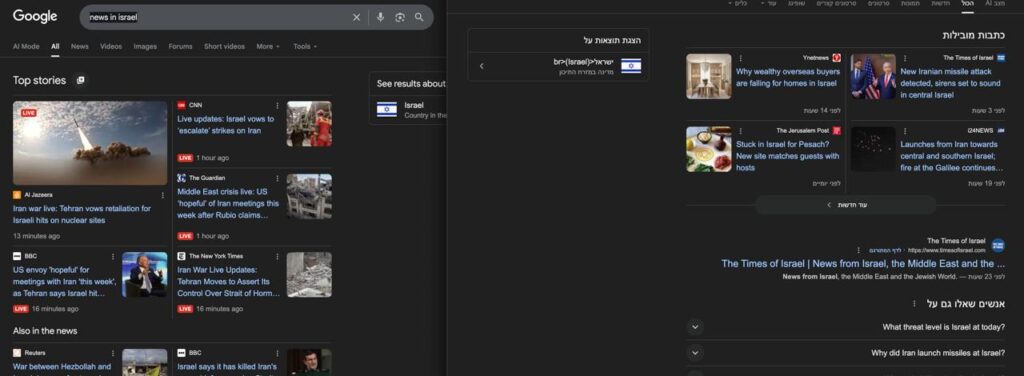
When a journalist in New York types “news in Israel” into Google, they get results from CNN, BBC, The Guardian, Al Jazeera, and The New York Times. The same big names that everyone is familiar with. But if someone in Israel does the exact same search, the results change dramatically — suddenly, it’s Ynetnews, The Times of Israel, The Jerusalem Post, and i24NEWS that dominate the page, covering local stories that never make it to the international spotlight: real estate trends, community.
Pesach plans, regional security updates, and grassroots reporting that the global outlets just overlook. That disconnect between what a journalist sees and what the local audience experiences?
That’s where stories fade away. And that’s precisely where an anti-detect browser can make a real difference.
The Problem: Your Browser Is Lying to You
Every time a journalist opens their default browser and researches a story, they are trapped inside a filter bubble shaped by their own location, language settings, search history, and device fingerprint. Google — and every other search engine — personalizes results aggressively. Two reporters covering the same event from two different countries will see fundamentally different information landscapes.
For a newsroom, this creates a dangerous blind spot. You’re not seeing the stories that local outlets are breaking. You’re not seeing the narratives that matter to people on the ground. You’re reading the same recycled wire reports that every other international outlet has already published — and calling it research. This isn’t just inconvenient. It’s a competitive disadvantage.
Here you can see on the left image which is Europe base computer searches “news in israel” versus left pane Israil based generated profile which shows local news rather than the international websites.
What an Anti-Detect Browser Actually Does for Journalists
An anti-detect browser lets you create isolated browser profiles, each with its own unique digital identity — location, timezone, language, device fingerprint, and proxy. When you build a profile set to Tel Aviv, your browser becomes a browser in Tel Aviv. Google treats you as a local user. News aggregators serve you local feeds. Social media algorithms show you region-specific trending topics.
In practical terms, this means:
Access to local source material. Instead of reading a CNN summary of events, you can pull up the original Hebrew-language report from a local Israeli outlet that broke the story six hours earlier. You see what local editors deemed important enough to headline — not what an international editor in London decided was worth covering.
Geo-specific trend monitoring. Stories don’t break globally first. They start locally. A housing crisis article in Ynetnews, a Pesach travel feature in The Jerusalem Post — these are the early signals that tell you where a bigger story is forming. By the time CNN picks it up, your competitor has already published.
Unfiltered search results. Your personal search history, past clicks, and browsing behavior warp what Google shows you. An anti-detect browser profile starts clean — no history, no bias, no algorithmic assumptions. You get the raw results that a first-time local user would see.
Multiple region monitoring from one desk. A single editor can maintain profiles for Beirut, Kyiv, Taipei, Lagos, and São Paulo — switching between them in seconds. No VPN juggling, no browser cache clearing, no hoping your incognito window is actually hiding your fingerprint (it isn’t).
A Real-World Comparison That Proves the Point
Consider a straightforward test: searching “news in Israel” from a standard browser versus an anti-detect browser profile configured with an Israeli IP and regional settings.
From a standard browser, the top results are predictable — CNN’s “Israel vows to escalate strikes on Iran,” The Guardian’s Middle East crisis live blog, BBC’s diplomatic coverage, and The New York Times with updates on Iran tensions. These are all valid stories, but they represent the same angle, filtered through the same international editorial lens. There is zero local flavor.
Now switch to the anti-detect browser profile. Immediately, the results shift. Ynetnews reports on overseas buyers entering the Israeli real estate market. The Times of Israel covers a new Iranian missile detection story with specifics the international outlets glossed over. The Jerusalem Post runs a feature on Pesach hospitality. i24NEWS reports on regional fire events and security developments in the Galilee.
These aren’t “lesser” stories. They’re different stories — the ones that give a reporter genuine insight into what’s actually happening on the ground, not just what’s been packaged for an international audience.
Why This Creates a Competitive Edge for Newsrooms
The news industry runs on speed and perspective. An anti-detect browser delivers both.
Speed: Local outlets break stories before international desks pick them up. If your reporters are monitoring local feeds through geo-targeted browser profiles, they catch stories earlier. Earlier access means earlier publication. Earlier publication means more traffic, more authority, and more reader trust.
Perspective: The most valuable journalism doesn’t just report what happened — it explains why it matters to the people living it. That context comes from local media. When your reporter can see that Israeli outlets are focused on housing and holiday logistics instead of geopolitics, that tells a story no international wire service is going to hand you.
Verification: Cross-referencing international reporting against local coverage is one of the most reliable ways to fact-check a story. If BBC reports a certain event, but no local outlet in the region mentions it, that’s a signal worth investigating. An anti-detect browser makes this kind of cross-regional verification trivially easy.
Source Discovery: Local news outlets, local forums, and region-specific social media trends are gold mines for finding sources. People on the ground are talking — but they’re talking on platforms and in comment sections that your default browser will never show you.
The Newsroom That Doesn’t Adapt Gets Left Behind
Every serious newsroom already uses multiple tools for research — media monitoring platforms, social listening tools, translation services, wire subscriptions. An anti-detect browser is not a replacement for any of these. It’s the missing layer underneath them all — the one that ensures the data you’re feeding into those tools isn’t pre-filtered by geography before you even start.
The reality is straightforward: if your competitor is using geo-targeted browser profiles and you’re not, they are seeing stories you aren’t. They are finding sources you can’t. They are publishing with a depth of regional context that you cannot match from a single-location browser.
In journalism, what you don’t see is what you don’t cover. And what you don’t cover is what someone else will.
Getting Started
Setting up an anti-detect browser for newsroom use is not complicated. Most platforms allow you to create profiles in minutes — select a region, assign a proxy, configure the language and timezone, and you have a fully isolated browser identity ready for research. Build profiles for each region your desk covers. Assign them to reporters. Make it part of the daily editorial workflow.
The stories are already out there. You just need the right browser to find them.
The difference between seeing what the world sees and seeing what the locals see is the difference between reporting the news and breaking the news. An anti-detect browser is how modern newsrooms close that gap.Share