

For years, anti-detect browsers have focused on spoofing browser fingerprints by modifying values such as the User-Agent, screen resolution, WebGL vendor, fonts, timezone, languages, and other JavaScript-exposed properties for Mobile Antidetect Browser.
A few years ago, this was often enough.
Today, it isn’t.
Modern bot detection platforms no longer rely solely on JavaScript values. Instead, they actively verify whether a browser behaves like the device it claims to be.
If a browser claims to be a Samsung Galaxy A56, security systems increasingly expect the graphics pipeline to behave exactly like a Samsung Galaxy A56—not like a desktop computer pretending to be one.
This is where many traditional anti-detect browsers begin to fail.
Why Mobile Spoofing Has Become Much Harder
Most anti-detect browsers generate a mobile fingerprint by changing values exposed to JavaScript:
- User-Agent
- Client Hints
- Platform
- Screen size
- Touch support
- Device Memory
- Hardware Concurrency
- Timezone
- Languages
While these values are important, they only describe the browser.
They do not describe how the browser actually renders graphics.
Modern anti-fraud systems have evolved far beyond checking JavaScript properties.
Instead, they issue rendering challenges.
For example, they may render invisible canvas elements and analyze characteristics such as:
- glyph rasterization
- font metrics
- anti-aliasing
- gamma curves
- shadow rendering
- subpixel positioning
- emoji rendering
- color interpolation
- GPU raster behavior
These characteristics are extremely difficult to fake because they originate deep inside the operating system’s rendering engine.
A desktop browser spoofing Android usually still renders like macOS or Windows underneath.
That difference is measurable.
The Hidden Problem with Most Mobile Profiles
Many anti-detect browsers advertise “Android Profiles.”
In reality, most of them simply change browser properties.
Internally they still use:
- desktop font rasterization
- desktop graphics stack
- desktop text rendering
- desktop gamma curves
- desktop font fallback
- desktop emoji rendering
To a human, everything looks correct.
To an anti-fraud engine, it does not.
The browser claims to be Android while producing desktop rendering characteristics.
That mismatch becomes a strong tampering signal.
Real-World Comparison
To evaluate how different solutions behave, we tested mobile profiles using the Fingerprint Pro Playground.
The goal was not to compare user interface features or automation capabilities.
Instead, we wanted to compare how convincing each browser’s mobile fingerprint appears to a modern fingerprinting engine.
Kameleo
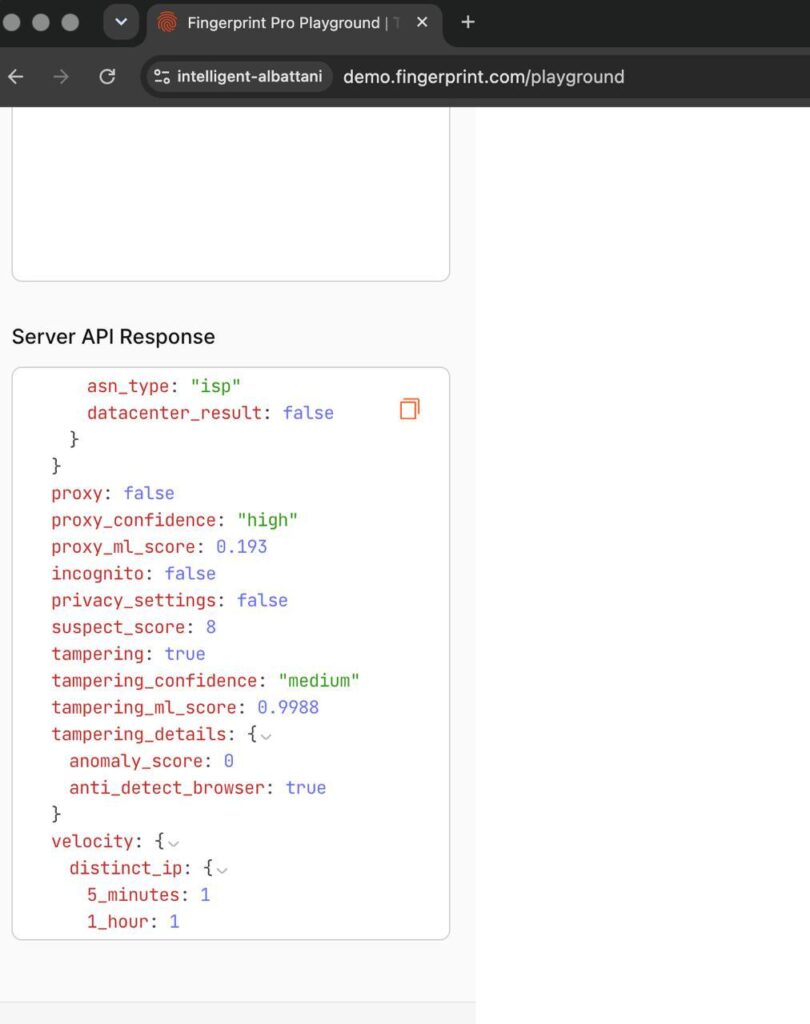
Kameleo correctly spoofs many browser properties, but the platform still detected browser tampering.
The reported tampering confidence remained extremely high, with an ML tampering score close to 0.9988, and the browser was identified as an anti-detect browser.
This indicates that although the JavaScript fingerprint appears mobile, deeper rendering characteristics still reveal inconsistencies.
AdsPower
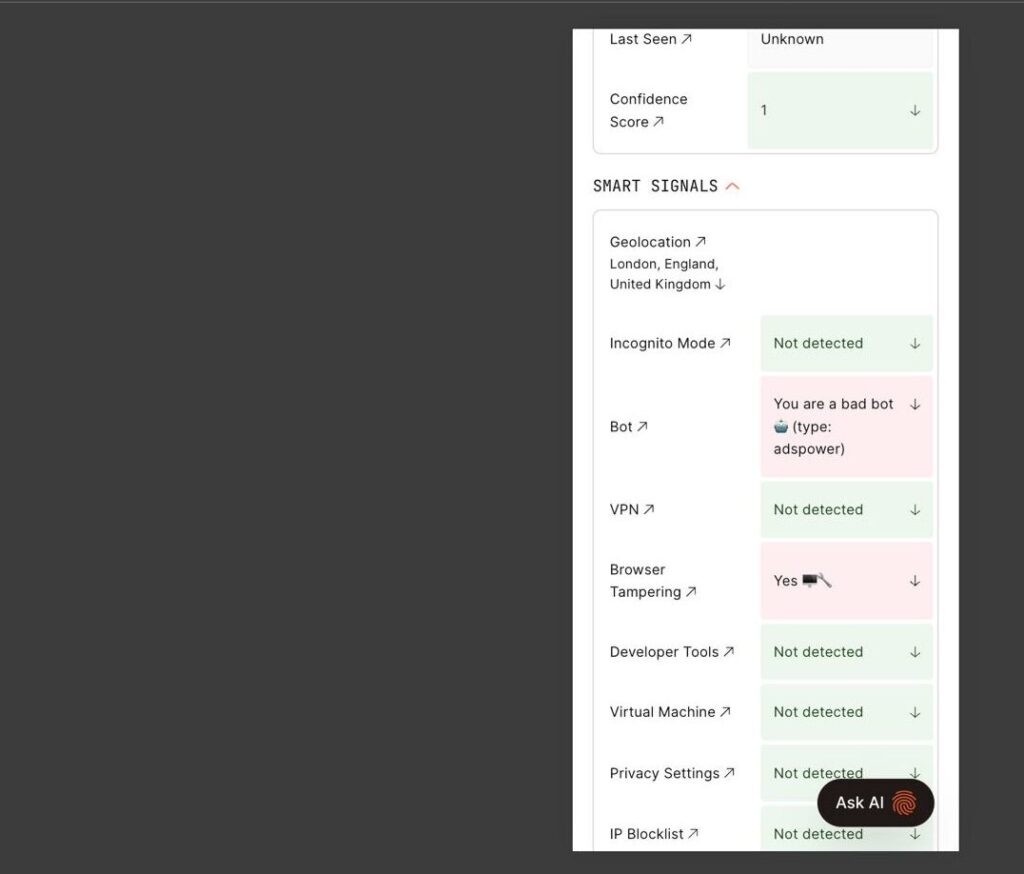
AdsPower performed even worse in this particular mobile test.
Fingerprint Pro explicitly classified the browser as:
Rather than simply detecting tampering, the system identified the anti-detect browser itself.
This demonstrates that matching JavaScript values alone is no longer sufficient against modern fingerprinting systems.
NullPrint
NullPrint approaches mobile emulation differently.
Instead of only modifying JavaScript-exposed properties, it focuses on reproducing rendering behavior that is expected from the claimed mobile device.
This includes realistic handling of mobile-specific rendering characteristics, such as:
- font rasterization
- font metrics
- glyph rendering
- gamma behavior
- shadow rendering
- canvas output consistency
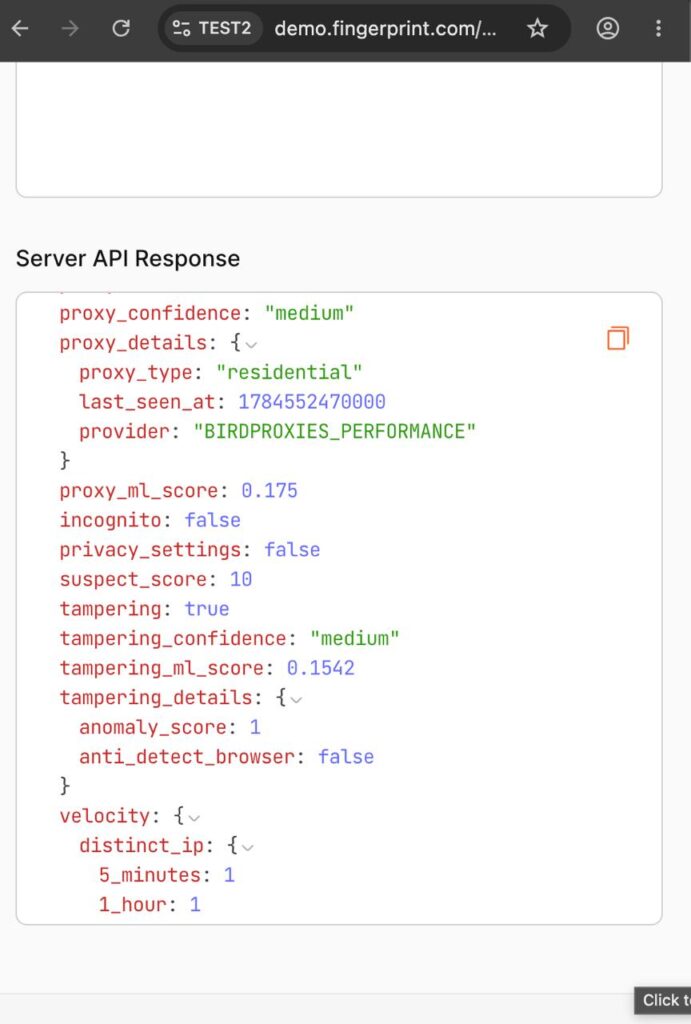
As a result, Fingerprint Pro produced significantly different results.
The reported values were:
- Tampering:
true - Anti-detect Browser: false
- Tampering ML Score: 0.1542
The important observation is not that tampering disappeared completely.
The important observation is that the detection engine did not classify the browser as an anti-detect browser, and the machine-learning tampering score remained dramatically lower than the other tested solutions.
Comparison
| Feature | AdsPower | Kameleo | NullPrint |
|---|---|---|---|
| Mobile User-Agent Spoofing | ✅ | ✅ | ✅ |
| Client Hint Spoofing | ✅ | ✅ | ✅ |
| Mobile Screen Emulation | ✅ | ✅ | ✅ |
| Touch Emulation | ✅ | ✅ | ✅ |
| Canvas Rendering Mimic | Limited | Limited | ✅ Device-oriented rendering |
| Font Rasterization Consistency | ❌ Desktop characteristics remain | ❌ Desktop characteristics remain | ✅ Designed to emulate mobile rendering behavior |
| Gamma / Shadow Consistency | ❌ | ❌ | ✅ |
| Anti-Detect Browser Flag | Detected (AdsPower) | Detected | Not detected |
| Fingerprint Pro Tampering ML Score | High | 0.9988 | 0.1542 |
Why Rasterization Matters
One of the biggest misconceptions in the anti-detect industry is that changing browser properties creates a believable mobile fingerprint.
It doesn’t.
Rendering is effectively a fingerprint of the operating system itself.
A browser running on macOS naturally produces macOS text rendering.
A browser running on Windows naturally produces Windows rasterization.
Android devices produce their own rendering characteristics.
If those rendering characteristics do not match the claimed device, modern detection engines can identify the inconsistency—even if every JavaScript property appears correct.
This is why canvas rendering has become one of the most valuable signals in modern fraud detection.
The Future of Mobile Anti-Detection
The industry is gradually moving away from simple property spoofing toward behavioral consistency.
As fingerprinting systems become more sophisticated, success depends less on changing browser values and more on reproducing how the claimed device actually behaves.
That includes:
- graphics rendering
- font output
- canvas behavior
- GPU characteristics
- rendering consistency
Simply claiming to be a mobile device is no longer enough.
The browser must also render like one.